New to Trading? Here’s What You Should Learn Before You Risk Your Money
If you're new to trading, you may already be asking:
“What trade should I take?”
Before you worry about what stock to buy, what option to trade, or how much money you could make, there is a more important question:
At UFL, or Unlocking Financial Literacy, we believe trading for beginners starts with education.
Not alerts.
Not copying somebody else's trade.
Not chasing whatever is moving that day.
You need a foundation.
Before putting real money at risk, new traders should understand the basics of how markets work, how to read price action, how to manage risk, and how to build a trading plan.
Here are 7 things every beginner trader should learn before trading with real money.
1. Understand How the Stock Market Works

You don't need to know everything about Wall Street before you start learning to trade.
But you should understand the market you're participating in.
The stock market allows buyers and sellers to trade shares of publicly listed companies. Stock prices can move based on supply and demand, company performance, economic information, news, expectations, and many other factors.
As a beginner, start by learning these basic trading concepts:
What a stock represents
Why stock prices move
Buying versus selling
Market orders versus limit orders
Bid and ask prices
Trading volume
Don't rush past the basics because they don't seem exciting.
Your foundation is what everything else gets built on.
If you don't understand the market, learning advanced strategies before learning the fundamentals can make trading even more confusing.
2. Learn How to Read Candlestick Charts
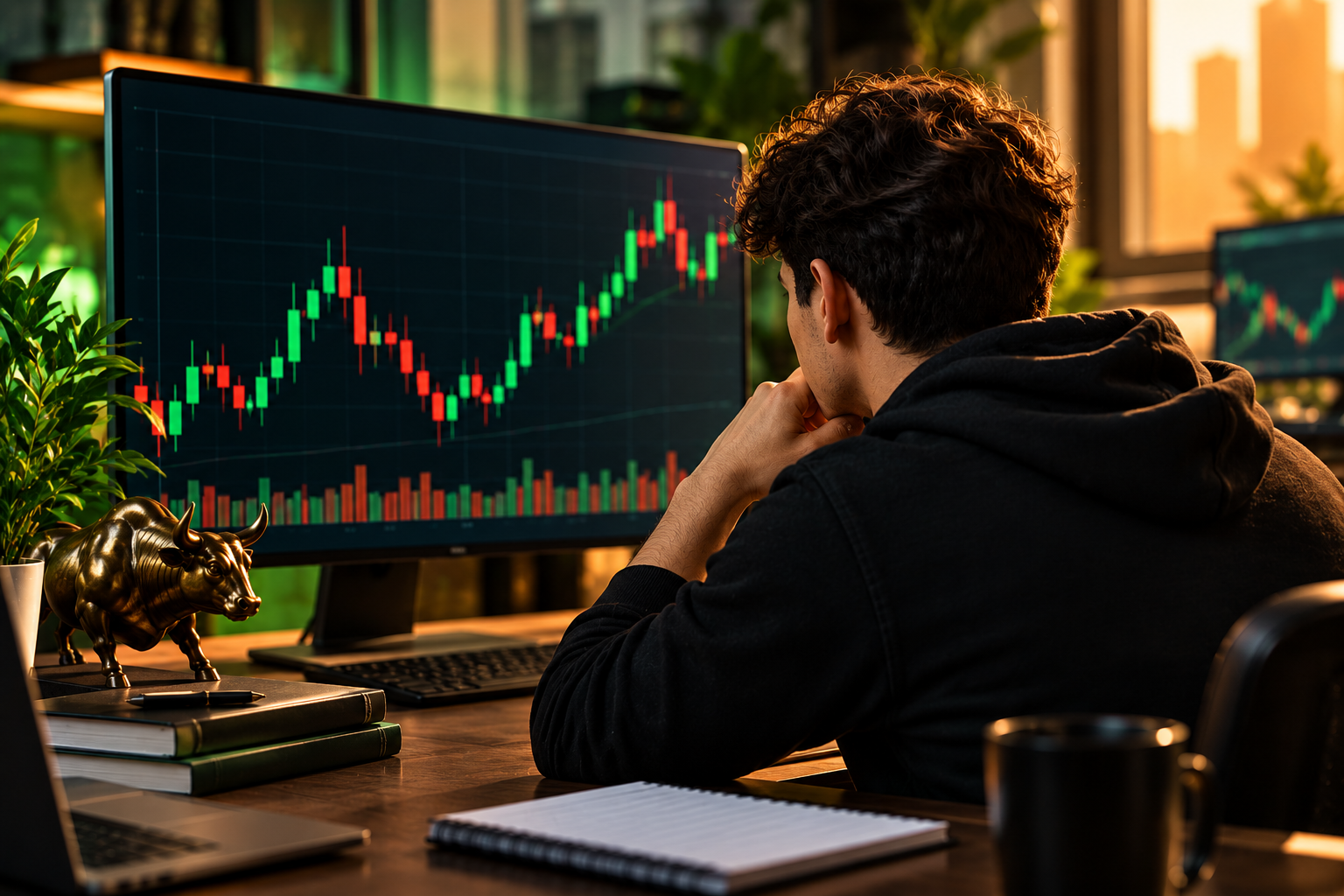
When beginners first open a trading chart, they often see red and green bars moving across the screen.
Those are candlesticks.
But candlesticks are more than red and green shapes.
A candlestick shows information about price during a specific period, including the open, high, low, and close.
Instead of immediately trying to memorize dozens of candlestick patterns, start by learning how to read what price is doing.
Ask yourself:
Where did price open and close?
How far did price move?
Who appears to be in control?
Did price reject a certain area?
What happened during the period represented by the candle?
You're learning to read the story price is telling you, not simply recognize shapes on a screen.
Understanding candlestick charts is one of the basic skills that can help beginners develop a clearer view of market price action.
3. Understand Support and Resistance
Once you can begin reading price, the next question becomes:
Where is price reacting?
That's where support and resistance come in.
Support is generally an area where buying interest has previously been strong enough to slow or reverse a decline.
Resistance is generally an area where selling pressure has previously been strong enough to slow or reverse an advance.
These aren't magical lines that guarantee what the market will do next.
Instead, traders can use support and resistance as part of their analysis to understand where price has reacted previously and where those areas may become important again.
The goal is to stop seeing random movement and start recognizing important areas on the chart.
4. Learn to Recognize Trend and Market Structure
Now zoom out.
Ask yourself:
What is the market actually doing?
Is price generally moving:
Higher?
Lower?
Sideways?
Understanding trend and market structure gives context to what you're seeing on the chart.
For example, traders may look for patterns such as:
Higher highs + higher lows = upward trend
Lower highs + lower lows = downward trend
However, don't rely on one piece of information by itself.
Candlesticks, support and resistance, trends, and market structure can work together to provide a broader picture of what is happening.
This is why building a strong foundation matters.
Before focusing on execution, you need to understand what you're actually looking at.
5. Understand Trading Risk Management
One of the first questions new traders often ask is:
“How much money can I make?”

A better question to learn to ask first is:
“How much can I lose if this trade doesn't work?”
Every trade carries risk.
Before entering a position, you should understand things such as:
How much of your account you're putting at risk
Where your trade becomes invalid
Where you would exit if you're wrong
Where you may take profit
Whether the potential trade fits your plan
This is where trading risk management becomes important.
Risk management doesn't eliminate losses. Instead, it helps you define your potential risk before entering a trade rather than making decisions emotionally after the trade moves against you.
Protecting your account gives you the opportunity to continue learning.
One trade shouldn't decide your future as a trader.
6. Create a Trading Plan Before You Enter a Trade
Having a trade idea is not the same thing as having a trading plan.
Before entering a trade, you should be able to explain:
What am I seeing?
Why am I considering this trade?
Where is my entry?
How much am I risking?
Where am I getting out if I'm wrong?
Where am I taking profit?
A trading plan creates a framework for making decisions before emotions take over.
If you can't answer those questions yet, that's information.
Don't trade yet.
Go back.
Study it.
Practice it.
Ask questions.
Then come back to the chart.
There will always be another trade.
You don't have to force a trade simply because the market is moving.
7. Don't Copy Trades You Don't Understand
This is an important lesson for beginner traders.
Seeing somebody post an entry doesn't mean you understand the trade.
You may know what they bought without knowing:
Why they entered
What they saw on the chart
How much they're risking
Their account size
Their exit strategy
What would cause them to change their plan
Following someone else's trade may show you what they entered, but it doesn't necessarily teach you why they entered.
The goal isn't to become dependent on someone telling you what button to press.
The goal is to develop the knowledge to understand why you're pressing it.
At UFL, we're not here to build trade followers.
We're here to build traders.
You Don't Have to Figure Out Trading Alone
Learning how to trade can feel overwhelming.
You open social media and see ten traders, ten strategies, and ten opinions, with everyone seemingly telling you something different.
That's one of the reasons UFL exists.
UFL, Unlocking Financial Literacy, is an education-first trading community designed to help beginner and developing traders build their knowledge and skills.
Inside Profit Takers, we're building a learning path that helps members move from the fundamentals into areas such as:
Chart reading
Market structure
Risk management
Trade planning
Execution
Continued practice and review
The goal isn't to rush beginners into trading.
The goal is to help them understand what they're doing.
Learn the lesson.
Practice the skill.
Ask questions.
Review your work.
Then build on it.
Learn first. Practice second. Execute when you're ready.
Frequently Asked Questions About Trading for Beginners
What should a beginner learn first about trading?
A beginner should start by understanding how the stock market works before focusing on individual trading strategies.
From there, learning how to read candlestick charts, identify support and resistance, recognize market structure, and understand risk can help build a stronger foundation for learning more advanced concepts.
Should beginners start trading immediately?
There is no requirement to start trading real money simply because you've started learning.
Taking time to study, practice, observe charts, and develop a trading plan can help you better understand the decisions involved before putting money at risk.
What is a trading plan?
A trading plan is a predefined framework for making trading decisions.
It can include the setup you're looking for, entry conditions, position size, risk, exit conditions, and profit-taking rules.
A plan helps define your approach before you enter a position.
Why is risk management important for beginner traders?
Trading involves the possibility of losing money.
Risk management helps traders define how much they're prepared to risk before entering a position rather than making that decision emotionally after the trade moves against them.
Understanding risk should be part of learning how to trade, not something added after a loss.
Can I learn trading by copying another trader's trades?
Following someone else's trade may show you what they entered, but it doesn't necessarily teach you why the trade was taken, how the risk was determined, or how the position should be managed.
Building your own understanding can help you make more informed trading decisions.
Ready to Build Your Trading Foundation?
If you're constantly looking at the market and thinking:
“Where do I even start?”
Start with the foundation.
Get the FREE UFL Before You Trade Blueprint and begin learning what comes before execution.
If you want to continue learning alongside other developing traders, explore the UFL Profit Takers Community.
Don't just look for the next trade.
Build the skills to understand it.
Educational Disclaimer
Educational purposes only. Trading and options involve risk and may result in financial loss. UFL content is educational and is not individualized investment advice.